Succession planting is one of the most practical ways to increase food production in a home garden without expanding your space. In this post; succession planting: how to grow more food we will break down what it is, how you can implement it into your current garden, and talk about all of the wonderful benefits this method brings to a grower!
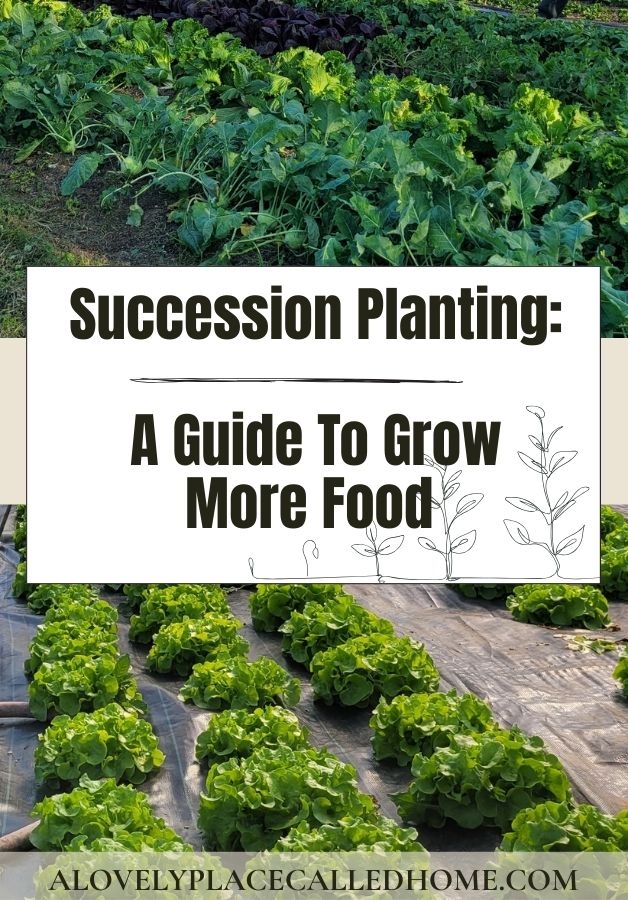
Succession planting can help solve one of the most common gardening problems: everything is ready at once, and then suddenly there is nothing left to harvest.
If you have ever dealt with feast-or-famine harvesting, succession planting is worth learning. Instead of planting one crop one time and harvesting it all at once, succession planting staggers your planting dates so you can spread out harvests over a longer period and make better use of every bed in your garden.
This method is often associated with market gardening, but it works just as well for home gardeners. Even a small garden can benefit from it! I learned this method when I read JM Fortiers book The Market Gardener Handbook (use my code alovelyplacecalledhome for 10% off)
I have come a long way since I first got my hands on that book. It’s quite life changing actually when I look back on my journey in market gardening.
Want To Listen Instead?
Instead of reading, you can listen to this post on your favourite podcast channel, or here with the podcast player below! I started this podcast for those of you who enjoy listening as you go about your daily lives. We are also on YouTube in video form so be sure to tune in and subscribe.

What Is Succession Planting? A Practical Guide for a Homesteader To Grow More Food Ep.5 – A Lovely Place Called Home
What Is Succession Planting?
Succession planting is the practice of staggering crops for continuous harvest.
Instead of planting lettuce once in May and harvesting it all at once, you plant it in stages. You also plan what will go into that bed before it and after it so one space can produce multiple crops over the course of the season.
For example, if carrots go into a bed on May 1 and their days to maturity give you a harvest date later in the season, you should already know what is going into that bed next. Once the carrots are pulled, the next crop is ready to take its place.
That is the heart of succession planting: planning ahead so your beds keep producing.
Why Succession Planting Works For The Home Garden
One of the biggest benefits of succession planting is that it turns one harvest window into several.
Instead of planting one bed of romaine lettuce and eating romaine for one week in July, you can stagger your lettuce plantings and enjoy a more continuous supply over the season. You can also use that same bed for a crop before the lettuce and another crop after it.
That means one garden space can potentially produce two, three, or even four rounds of food instead of just one.
For a home gardener, that is a huge gain.
Best Crops for Succession Planting
Succession planting works best with crops that have a fast days to maturity (DTM).
Days to maturity refers to the time from sprouting to harvest. The shorter the crop’s DTM, the easier it is to fit multiple rounds into one growing season.
Some of the best crops for succession planting include:
- Lettuce
- Arugula
- Spinach
- Dill
- Cilantro
- Radishes
- Beets
- Bok choy
- Green onions
- Baby greens
These crops mature quickly and are ideal for repeated plantings.
Longer crops like tomatoes, pumpkins, corn, cucumbers, squash, and storage cabbage usually stay in the garden much longer, so they are not always the best fit for traditional succession planting unless you are using season extension methods.
Succession Planting in a Small Home Garden
You do not need a market garden to use this method.
Even if you only have a 10-by-20-foot garden, succession planting can help you get more food out of the same space.
Let’s say you normally plant one patch of romaine lettuce. In a typical garden, that lettuce all matures at once. You eat salads for a week, maybe give some away, and then that harvest is over.
With succession planting, you can spread that crop out and also use the bed more efficiently. You might grow a quick spring crop before your lettuce goes in, harvest the romaine in mid-season, and then follow it with another fast crop afterward.
Instead of one planting and one harvest, you now have multiple rounds coming out of the same garden space.
That is how succession planting increases home food production.
How to Plan Succession Planting
Succession planting is not something most people can do well off the top of their head. It needs a plan.
Here are the main things you need to work through.
1. Know Your Frost-Free Growing Days
Start by figuring out how many frost-free days you actually have in your growing season.
That gives you your baseline. If your growing season is 120 frost-free days, you need to know that before you start planning how many crops can realistically fit into one bed.
If you use season extension, that can give you more flexibility, but your frost-free days are still the place to start.
My article (74 Cool Weather Plants To Grow For Years Of Free Food – Zones 4-8) can give you inspiration if you are in a colder climate like me!
2. Find the Days to Maturity for Your Crops
Look up the DTM for the crops and cultivars you grow most often.
You can usually find this:
- On the back of seed packets
- On plant tags
- On seed company websites
Write them down in one place so you are not constantly re-checking them.
3. Add the Harvest Window
Not every crop is harvested on one exact day.
Some crops have a longer harvest window, while others need to be picked right away.
Carrots can often stay in the ground longer. Lettuce gives you a bit of flexibility. Peas, beans, cucumbers, and tomatoes are less forgiving once they hit maturity.
Adding the harvest window into your plan gives you breathing room and makes your timing more realistic.
4. Map It Out
You need some kind of visual plan.
That might be:
- A notebook
- A chart
- A calendar
- A crop planning app
For years, I mapped everything out on paper with grids and colours. Now I use a crop planning app, which makes the whole process much easier. But whether you do it digitally or on paper, the key is to have something you can actually refer back to.
Because in the middle of summer, you will not remember it all.
I have been using Heirloom crop planning app for years now and I will never go back! It was created by JM Fortier so you know it’s going to be amazing. You can use it on your computer or your phone too, so it’s a win win.
Starting Crops in the Nursery
One of the biggest ways to improve succession planting is to start more crops in the nursery instead of direct sowing everything into the ground.
This cuts down the amount of time a crop spends taking up bed space in the garden.
For example, transplanting lettuce instead of direct sowing it can save time, improve consistency, and make your succession schedule easier to manage. The same goes for many crops that people do not always think of starting in trays, like beets.
Starting more in the nursery helps by:
- Shortening time in the bed
- Improving germination consistency
- Reducing thinning work
- Giving plants a better start
- Making succession timing easier
If you are serious about increasing production in a limited space, this can make a big difference.
My Personal Gardening Method
My own garden is laid out in 30-inch beds with 18-inch pathways outside. In covered spaces like caterpillar tunnels, the paths are narrower so I can maximize protected growing area.
I use 25-foot beds because that size gives me more flexibility. I used to run 50-foot beds, but I found they did not work as well for the range of crops I wanted to grow. Cutting those longer beds down gave me more variety, more manageable successions, and a better overall rhythm.
I also use season extension heavily because my growing season is limited and our weather can be unpredictable. Storage crops often go in by mid-August, and I rely on low tunnels and covered systems to protect more vulnerable crops like tomatoes, cucumbers, lettuce, and kale.
That combination of smaller beds, succession planning, and season extension has given me a much more productive and resilient garden.
How Succession Planting Changes Your Garden
There are several major benefits that come from using this method.
1. Steady Harvests Over Time
Instead of having one large wave of harvest, you get a more continuous supply of food.
This makes it much easier to use what you grow.
2. Less Waste
When everything matures at once, food often gets wasted. Succession planting spreads things out, so your family is less likely to get overwhelmed by one crop and less likely to let it spoil.
3. More Diversity in the Same Space
Because you are working in stages, you can fit more variety into the same square footage.
Instead of one type of lettuce once, you can grow several types over the season.
4. Better Soil Health
Succession planting naturally supports better crop rotation and better soil management.
Some crops are heavy feeders and take a lot from the soil. Others are lighter feeders. By rotating what goes into a bed and amending as you go, you can reduce depletion and avoid constantly growing the same thing in the same space.
This matters more than many gardeners realize.
Healthy soil affects:
- Yield
- Plant health
- Pest pressure
- Disease resistance
- Overall garden resilience
5. Less Overwhelm
This is one of the biggest benefits.
Succession planting spreads out:
- Planting
- Harvesting
- Weeding
- Transplanting
- Nursery work
Instead of having one huge push all at once, the work is broken into smaller, more manageable pieces throughout the season.
Adjustments I Made Over Time
Like most gardening systems, my approach to succession planting has changed through trial and error.
One thing I love now is intercropping.
I like pairing crops that work well together in the same bed. One of my favourite combinations is kale and bok choy. The bok choy matures quickly while the kale takes longer to fill out. By the time the bok choy is harvested, the kale has grown enough to create canopy over the bed, which helps suppress weeds and protect the soil.
Another major adjustment was what I put in my pathways.
I now use fine wood shavings in the paths between my beds. That has helped a lot with weed suppression and has made the garden easier to maintain. It also fits our setup well because we have access to sawdust and wood shavings given we are constantly processing firewood and running our sawmill.
These small changes have made the whole system more efficient and more enjoyable.
One Unexpected Benefit: A More Beautiful Garden
One surprise I learned through succession planting is that it makes the garden beautiful for much longer.
Because things are always being planted, growing, maturing, and finishing, the garden always feels alive. There is always something happening. There is always something fresh coming in, something ready to harvest, and something just beginning.
That constant movement gives the garden a completely different rhythm.
Start Small
You do not need to overhaul your entire garden to try this.
Start with one bed.
Take one crop that you usually plant once and ask yourself:
- Can I stagger it?
- Can I get another crop before it?
- Can I get another crop after it?
Even one or two successful succession-planted beds will show you how effective this method can be.
Final Thoughts
Succession planting is one of the most practical systems a home gardener can learn.
It helps you:
- Increase food production
- Reduce waste
- Use your space better
- Improve soil health
- Spread out the workload
- Harvest over a longer season
It works in large gardens, small gardens, market gardens, and home gardens!
You do not need more land to get more food. Often, you just need a better system. So get your seeds out, write down your days to maturity, look at your frost-free days and make a plan.
SUCCESSION PLANTING: HOW TO GROW MORE FOOD
More gardening posts you might like:
SUCCESSION PLANTING: HOW TO GROW MORE FOOD

Leave a Reply