Today we’re breaking down what it looks like for someone starting an egg business and what you need to know. Whether your motivation is a small side hustle or something large enough up to bring a decent profit to the homestead. I’m also including a printable PDF egg business calculator which is located at the bottom of this post!
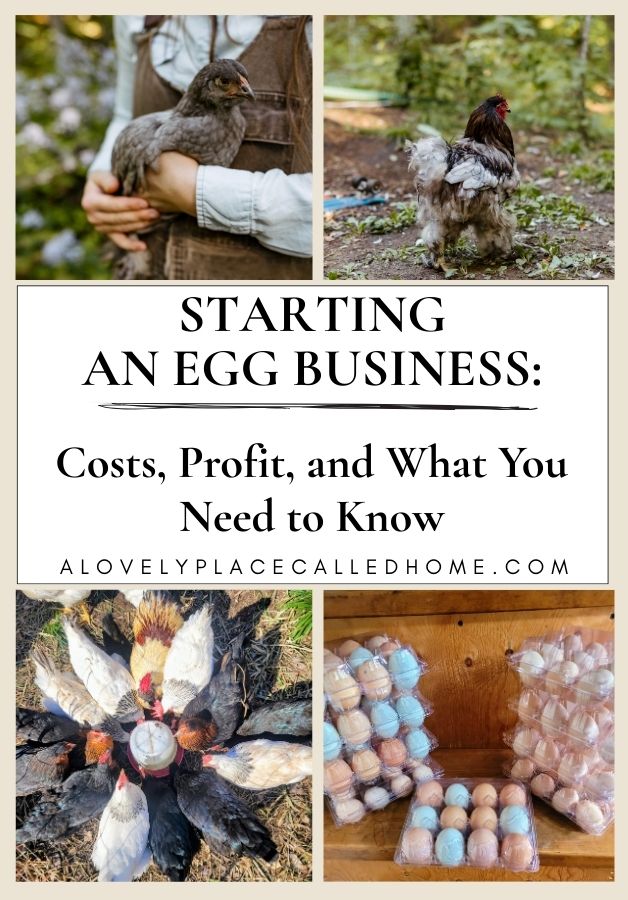
We’re going to walk through:
- Flock sizes (50, 100, and 500 layers)
- Feed costs
- Weekly revenue
- Realistic profit
- Management requirements
- Where you insert your own numbers
Let’s run it.
Listen Instead!
A Lovely Place Called Home has a podcast! Listen to the audio or video version of this post in even more depth.

STARTING AN EGG BUSINESS: WHAT YOU NEED TO KNOW

Starting an Egg Business: Costs, Profit, and What You Need to Know Ep.4 – A Lovely Place Called Home
First: A Quick Note on Bird Cost
I am not including the cost of your birds in the base projections below.
Why?
Because bird cost varies dramatically:
- Buying day-old chicks
- Buying ready-to-lay pullets (18–25 weeks)
- Hatching your own
- Raising from scratch with feed input
Instead of muddying the math, I recommend this approach:
- Calculate your weekly profit.
- Treat your birds as an investment.
- Pay yourself back weekly from profit (like a car payment).
Example:
If your birds cost $1,000 and you want them paid off in 20 weeks, divide $1,000 by 20. That’s your weekly repayment amount.
Clean and simple!
The 50 Layer Model (My Favourite Starting Point)
If you’ve never sold eggs before, I strongly recommend starting with 50 layers.
It sounds like a lot. But it isn’t, trust me!
Fifty chickens does not feel like commercial farming. It still feels homestead-level and family friendly. Kids can help. It’s manageable. It’s scalable.
Production Assumption (Year One)
We’re using:
- First-year, ready-to-lay hens
- 100% production for simple math
50 birds = 50 eggs per day
350 eggs per week
≈ 29 dozen per week
For safety and family use, I recommend selling 20 dozen per week, keeping the rest for your household or buffer.
Revenue (Farm Gate Pricing)
In my area (Ontario), farm gate eggs sell for $6 per dozen, regardless of organic vs non-organic feed.
20 dozen × $6 = $120 per week revenue
Feed Costs
Each hen eats approximately 1.5 lbs of feed per week.
50 birds × 1.5 lbs = 75 lbs of feed per week
At my pricing (bulk organic layer ration):
≈ $40 per week in feed
(Insert your own feed cost here — always project slightly high.)
Bedding / Miscellaneous
I allow:
- $10 per month for shavings (deep bedding method)
- Optional packaging costs if you buy new cartons or add branding
Weekly Profit (50 Layer Model)
Revenue: $120
Feed: -$40
Shavings allowance: minimal
Estimated weekly profit: ≈ $80
That’s roughly:
- $320 per month
- $3,840 per year
From 50 chickens.
And they’re laying whether you sell them or not.
The 100 Layer Model
If you have space and want to grow, here’s what that looks like.
100 birds
= 100 eggs per day
= 700 eggs per week
≈ 58 dozen per week
Again, I’d project conservatively and sell 50 dozen.
50 dozen × $6 = $300 per week revenue
Feed Costs
100 birds × 1.5 lbs = 150 lbs per week
That’s about:
$60–$80 per week in feed
(I’d project $75 to stay safe.)
Weekly Profit (100 Layers)
Revenue: $300
Feed: -$75
Estimated weekly profit: ≈ $225
That’s about:
- $900 per month
- $10,800 per year
At this level, you’ll want to start considering:
- Branded cartons or bulk flats
- Legal requirements for your province/state
- Packaging costs
- Storage and refrigeration
The 500 Layer Model (Scaling Hard)
This becomes real production.
500 birds
= 500 eggs per day
= 3,500 eggs per week
≈ 291 dozen per week
At $6 per dozen:
291 dozen × $6 = $1,746 per week
That’s serious volume.
But so are the risks.
Feed Requirements
500 birds × 1.5 lbs = 750 lbs per week
That’s:
15 × 50-lb bags every week.
At this scale, you must consider:
- Bulk feed delivery
- Storage infrastructure
- Predator pressure
- Possibly livestock guardian dogs
- Legal restrictions in your area
This level is no longer “side hustle.” It’s production farming.
Daily & Weekly Management
Chickens are low maintenance — but not no maintenance.
Daily:
- Feed
- Collect eggs (I collect twice daily)
- Check birds
- Close coop at night (non-negotiable)
Weekly:
- Refresh water tanks (if using bulk systems)
- Check bedding condition
- Inspect nesting boxes
- Monitor for egg-eating behavior
Seasonal:
- Deep clean coop (deep bedding method recommended)
- Cull or retire older birds
- Reassess production rate
I use a deep bedding system — up to 18 inches of shavings — and clean seasonally. This drastically reduces labour compared to weekly cleanouts.
Legal Considerations
This varies heavily by region.
In Ontario:
- Farm gate sales are fairly lenient.
- Selling to restaurants requires graded eggs (illegal without it).
In some U.S. states:
- You cannot sell eggs in reused cartons.
- Labeling requirements vary.
Call your township or state office before scaling.
Packaging Options
You can:
- Use recycled cartons (if legal in your area)
- Buy bulk flats
- Add farm stickers
- Require customers to bring their own containers
- Let customers pick their own eggs from flats
At small scale, keep it simple.
At larger scale, branding becomes more important.
Where to Insert Bird Cost in your egg business
Add bird repayment into your weekly expense column.
Example:
Birds cost $1,000
You want them paid off in 20 weeks
$1,000 ÷ 20 = $50 per week
Add that $50 into your weekly expense line until paid off.
Treat it like equipment repayment.
Download and print this free egg business calculator!
Final Thoughts
Egg production is:
- Family friendly
- Scalable
- Predictable
- Math-driven
- Low overhead compared to most livestock
And the birds are laying regardless.
If you want to start small, start with 50.
If you want to scale, run the numbers first.
Always project feed slightly higher.
Never underestimate predator pressure.
And treat your initial investment like a repayment system.
STARTING AN EGG BUSINESS: WHAT YOU NEED TO KNOW

Great breakdown on the egg business side of homesteading. A lot of people jump in without thinking about the business structure and tax side of things. If you are selling eggs or any homestead products, having a proper business address set up in a tax-friendly state can save you a lot of headaches down the road, especially for folks who move around or live in states with high income tax.
thankyou! I agree!